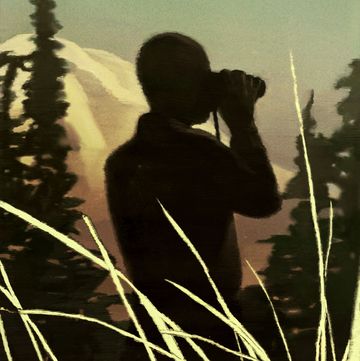
October 11, 1923, was a perfect fall day in the Siskiyou Mountains of southern Oregon. Steep slopes of dark green ponderosa pine and Douglas fir rose to a clear blue sky, while red maples and yellow cottonwoods filled the Rogue Valley below. A brisk breeze carried the smell of evergreens and the promise of cold nights.
Around noon, train 13 of the Southern Pacific Railroad chugged out of the sleepy town of Ashland. It was headed toward San Francisco, but first it had to travel through a half-mile tunnel, just before it would cross the California state line.
The train snaked its way up switchbacks that were so steep, a second steam locomotive had to help pull it. Passengers finished up their lunches and took in the views or discussed recent events. The sudden death of Warren G. Harding in early August had shocked the country and left “Silent Cal” Coolidge in charge at the White House. A day earlier, Giants outfielder Casey Stengel had smashed a ninth-inning inside-the-park home run to beat the Yankees in the first game of the World Series. Game 2 had just started as the train was pulling out of town; would Babe Ruth be able to rescue the Bronx Bombers?
As it neared Siskiyou Pass at 4,129 feet, the train stopped at the northern end of Tunnel 13. Built in 1887, the tunnel had been the final link connecting Oregon and California by rail. A 23-year-old nurse named Lawrence Joers was among a handful of passengers who disembarked to watch the crew uncouple the helper engine, fill the tender with water, and test the air brakes for the coming descent.
This article appears in Issue 36 of Alta Journal.
SUBSCRIBE
Engineer Sidney Bates climbed down from the cab of the locomotive with a large oilcan. A slightly built 51-year-old with a receding hairline, Bates had worked for the railroad for almost 30 years. “He’s a lucky old fellow,” a crewmember told Joers. “This is his last trip.… He’ll enjoy a nice pension after all these years of work.”
A conductor shouted “All aboard!” and everyone scrambled back to their seats. Bates eased the throttle forward, and the train crept into the dark tunnel. Partway through the passage, however, the train slowed and stopped.
After almost 10 minutes with no explanation for the delay, the passengers began to grow frustrated as well as lightheaded from the engine smoke that drifted into the cars. They didn’t know that Bates was not alone in the engine cab.
Suddenly, a massive explosion rocked the tunnel, snuffing out the train’s lights and shattering the windows. Women screamed and children wailed. Joers found a conductor with a flashlight, and they began to work their way through the cars, offering help where they could. Passengers were panicking in the dark, many bleeding from flying glass.
Several men had jumped onto the tracks and set off toward the engine. Among them was Coyl Johnson, an off-duty Southern Pacific brakeman who was traveling as a passenger. Johnson was turning 37 the next day, and his wife was planning a party for when he returned from San Francisco.
Smoke burned their eyes and lungs as they made their way up the muddy path alongside the tracks past the train’s eight cars. They could barely hear one another over the clang of the bell and the roar of the steam. The locomotive’s engine must have exploded, someone shouted. A wall of steam filled the far end of the tunnel. They could see the shadows of men moving across it, backlit by the sun.
The mail car, immediately behind the engine, was a tangled mass of blackened steel full of burning letters and parcels. Johnson edged forward alone into the smoke toward the wreckage, holding a red flare high as he disappeared. A few moments later, a volley of what sounded like gunshots echoed down the tunnel.
Joers and the conductor reached the mail car, which looked as if it had been torn open by a bomb at one end. The conductor boosted Joers through the hole and handed him his flashlight. Joers called out to the mail clerk who would have been riding inside. Smoldering piles of envelopes rose past his knees. Joers stumbled over something in the dark and recoiled in horror—it was the postal clerk’s head and naked chest. Other body parts lay scattered around the car.
Emerging from the smoke-filled tunnel, Joers and the conductor found Bates in the engine cab, his glasses still on but his eyes empty. Johnson’s body lay sprawled on the ground, his red flare still burning next to him. He was barely alive and died in their arms. Another body lay on the far side of the engine. All three men had been shot.

FRONTIER JUSTICE
Rescuers and law enforcement arrived almost immediately; the noise of the blast had been heard as far away as Hilt, California, four miles south. They also thought the train’s engine had exploded, but the scene of destruction they found was every bit as bad: the burning mail car ripped open like a torpedoed ship, three bodies lying lifeless and a fourth in pieces.
Railroad workers pulled the engine and the mail car out of the tunnel and put out the fire. Medical personnel treated more than a dozen passengers for bruises and gashes from flying glass.
Then the search for the culprits began. Over the following days, hundreds of men poured into the area to help search the hills. Local sheriffs formed posses of officers and volunteers who trailed bloodhounds brought in from as far as Seattle. Armed men guarded nearby roads and trails, and state militia members marched through the trees in khaki uniforms. Airplanes buzzed the mountains, one of the first instances of planes being used in a manhunt in the United States.
Special agents from the Southern Pacific Railroad arrived at the scene, led by Chief Special Agent Daniel O’Connell. They were joined by members of the U.S. Postal Inspection Service, under Inspector in Charge N.W. Charles Riddiford.
The Postal Inspection Service was the premier federal law enforcement agency of the period. It was older than the country itself, dating to when Benjamin Franklin appointed the first surveyor general of post roads in 1775. Postal inspectors’ job was to ensure the efficiency and safety of the mail network, and at this they were remarkably effective.
Valuable items were frequently sent through the postal system during the 19th and early 20th centuries, from cash and bonds to precious metals and payrolls. (There were even a few instances of children being sent by mail—safely—when parcel post service was introduced in 1913.) Armed postal agents sat beside stagecoach drivers—hence the term riding shotgun—and they eventually shifted to trains as the bulk of mail service did.
Train robbery was a distinctively American crime that followed a rapidly expanding network of routes, often through remote and lawless regions. Railroads were seen as a symbol of wealth and progress, and infamous train robbers like Butch Cassidy and Jesse James were romanticized as modern-day Robin Hoods in dime novels and Wild West shows. In 1903, theater crowds gasped at the end of The Great Train Robbery, one of the first popular silent pictures, when the gang leader emptied his pistol point-blank at the audience.
In many ways, robbing a train was easier than robbing a bank. Security was lighter, and it was less difficult to flee from the middle of nowhere than from the center of a city. But escaping entirely was another story. As train robberies peaked toward the end of the 19th century, the agents of the Postal Inspection Service became known for their unrelenting pursuit of criminals.
Nonetheless, gangs targeted mail trains across the West well into the early 20th century. From 1919 to 1921, criminals stole roughly $6 million from the mail system. There had even been several train robberies in Oregon, including more than one shoot-out—but nothing like the massacre at Tunnel 13.
The manhunt expanded across southern Oregon and northern California. Vigilante groups scaled mountains and trudged through old-growth forests, stumbling across illegal moonshine stills and camps left by deer hunters. Railroad men formed posses of their own, armed to the teeth and out for revenge for their murdered coworkers. (“If we’d caught those fellows we wouldn’t have brought them back alive!” one said later.) A National Guard general said he would issue shoot-to-kill orders; a local paper reported that if the robbers were caught and cornered, “authority would be given for howitzers and high explosives from National guard armories to be used against them.”
The senseless brutality of the crime made it national news. The Postal Inspection Service and the railroad claimed that nothing of value had been stolen, yet four men had been murdered inside Tunnel 13.
At night, residents locked their doors and piled furniture against them. Mothers told their children that the robbers would get them if they misbehaved. Rumors flew: It was an inside job; the suspects had outside help; they had been spirited away in a car or flown off in a plane. According to a clairvoyant consulted by a local paper, they had made off with six figures in cash by blending in with the other passengers.
Whoever they were, the criminals had left behind a surprising amount of evidence. Investigators quickly found a dynamite detonator and a Colt .45 pistol near the tracks. Three backpacks, pairs of footpads soaked in creosote—presumably to confuse bloodhounds—and a pair of bibbed overalls turned up nearby. After a strong breeze made people start sneezing, the police realized the robbers had spread pepper on the ground, also to throw dogs off their scent. Investigators also discovered a cabin, where they found cartridges from a .45 and other supplies that indicated someone had been there recently.
Yet agents were still mystified by the basic facts of what one newspaper was calling “the boldest train robbery since the days of the Old West.” Nobody could even say how many suspects there were, since every eyewitness was dead. Why had they picked this particular time and place and train? Were they professionals or, as the wealth of clues suggested, a bumbling bunch of amateurs? And if the latter, how had they simply vanished?
It was becoming clear that the investigation needed outside help—and Chief Special Agent O’Connell knew whom to call.

SCIENCE VERSUS CRIME
In the early 1920s, forensic science was still in its infancy. The first police crime laboratory had been set up only 13 years before in Lyon, France. Investigators were just starting to move beyond pseudosciences like phrenology—identifying criminals by their skull shape—into evidence-based techniques like microscopy and ballistics. But juries and law enforcement departments still didn’t trust the eggheads in lab coats talking about fingerprints, especially if their results disagreed with the findings of experienced officers who relied on old-fashioned shoe leather and instinct.
Oscar Heinrich, a professor of criminology at UC Berkeley, was the leading egghead of his time. A slight man with thinning brown hair and round rimless glasses, Heinrich worked out of a private lab when he wasn’t teaching. He was known for his obsessive precision, recording every penny he spent and toiling in his basement lab around the clock, surrounded by crucibles, test tubes, and beakers.
Heinrich worked on hundreds of cases per year, from forgeries to kidnappings to murders. He could tease out evidence from the tiniest clues, such as human hairs and single threads of fabric. He eventually gained such a reputation that it was said suspected killers would confess after hearing that Heinrich would be on the witness stand.
In 1921, Heinrich, already nationally famous, played a key role in the trial of the silent-film star Roscoe “Fatty” Arbuckle, who had been accused of raping and fatally injuring a young actress during a party at a San Francisco hotel. Heinrich testified for the prosecution, linking Arbuckle to the crime through fingerprint analysis. Arbuckle was eventually acquitted, but his reputation was destroyed.
The case made Heinrich the country’s most celebrated forensic scientist. His techniques were as groundbreaking as his attitude was antiseptic. In his world, guilt or innocence hinged on indisputable evidence, not hearsay or gut feelings. When the press called him “America’s Sherlock Holmes,” he scoffed. “Holmes acted on hunches,” he said. “And hunches play no part in my crime laboratory.”
The Southern Pacific Railroad had already enlisted Heinrich on several cases. O’Connell sent the evidence from Tunnel 13 to Berkeley, and Heinrich started poring over the items, taking meticulous notes as he went. He saw that the serial number of the Colt .45 had been almost entirely filed off, but he knew there was a second set of the numbers inside the gun. He identified a pink stain in the grip as toothpaste and a white stain as shaving soap.
Digging into the pockets of the overalls, Heinrich found needles from Douglas firs and leaves from salal shrubs, species that were native to the local forests. Federal agents had thought that a sticky substance on one pocket was engine oil or grease and concluded that the owner was a mechanic. But when Heinrich looked closely, he found that it was pitch from a fir tree. In the Pacific Northwest, that meant that whoever wore these overalls was almost certainly a lumberjack.
To estimate the owner’s height, Heinrich nailed the overalls to a door, rolled up the pant legs as he knew loggers did, and placed a pair of boots under them. He vacuumed fingernail clippings out of one pocket and found a few hairs caught in one of the buckles. Peering through a microscope, he noted that they were “medium to light brown” and, based on their condition, appeared to be from someone in their early 20s.
“The wearer and owner was a lumberjack employed in a fir or spruce logging camp,” Heinrich told O’Connell. “A white man not over five feet ten inches tall, probably shorter. Weight not over 165 pounds, probably less.” The culprit was around 25 years old and unusually fastidious for a logger, he added. Based on wear patterns on the straps and pockets, he was likely left-handed.
A critical piece of evidence came almost by chance. On his second close examination, Heinrich noticed a small, narrow pocket in the breast of the overalls that was just large enough to fit a pencil. He reached in with a crochet hook and fished out a tiny ball of dried paper.
He carefully steamed it open and ironed it flat. It was faded from repeated washings, but it was a registered mail receipt for $50, sent from Eugene, Oregon, to New Mexico, dated September 14. The sender’s name was Roy DeAutremont.

HARD TIMES
As investigators were combing the hills around the tunnel for any signs of the robbers, Roy DeAutremont was just a few miles away. Roy; his twin brother, Ray; and their younger brother Hugh were huddled on the bank of a stream under a huge log that had fallen across it, freezing but afraid to light a fire, listening to airplanes circle overhead and wishing they were anywhere else on Earth.
Roy and Ray were 23, the oldest of five brothers. Their father, Paul, was a barber who had dragged his wife and children around the South and Midwest in search of work. By the time the twins were teenagers, the family was scraping a living on a farm in New Mexico.
“We sweated, broke our backs and dug until our hands were covered with blisters,” Ray said later. “But when we raised a crop, the crop buyers would cheat us out of our money. Cattlemen took our water from us and we couldn’t do anything about it.… We just had to sit there and watch while they robbed us blind.”
Like most boys in rural America, the DeAutremonts grew up handling shotguns and rifles. “Those were wild lawless days and it was hard for a good boy to remain good,” Roy said. “If a boy were good he was looked upon as a sissy.”
When the stress of poverty proved too much for the marriage, Paul moved to Colorado, leaving the boys with their mother. The twins left home themselves at the age of 16 or 17. Hugh, who was four years younger, stayed behind. Roy and Ray found jobs as barbers in Oklahoma, but Ray soon left to hop freight trains looking for work. He ended up in a shipyard across the Columbia River from Portland, Oregon, where he was active in the Industrial Workers of the World, a labor organization that advocated for fair pay and workers’ rights.
The aftermath of World War I was a time of massive labor strikes and violent pushback from law enforcement, fueled by economic instability and the fear of communism. In November 1919, Ray was one of more than a thousand people swept up by police after a deadly riot in Centralia, Washington. Roy immediately left his barbershop and came to help his brother in court, but he was too late. Ray had been charged, on flimsy evidence, with “criminal syndicalism,” and after an unsuccessful escape attempt, he was sentenced to one year at the Washington State Reformatory.
“They treated him like he was a dumb brute,” Roy said, describing how his brother was thrown in “the hole” with nothing but bread and water. The experience “[made] a different man out of Ray and planted into his heart a feeling of bitterness, toward society.”
When Ray was released in May 1921, the decade was just starting to roar. But like many working-class men, he and his twin brother struggled to find steady work. Roy’s eyesight was failing, and he had to stop cutting hair. Ray wrestled with anger, resentment, and depression. “Hatred ate away at my compassion as I saw how the people in power cheated and stole from the masses,” he later said. He began hopping trains again, and on one journey he passed through a tunnel at the summit of the Siskiyou Mountains.
In the summer of 1923, Hugh joined his brothers in Oregon. He had just graduated at the top of his high school class in New Mexico, where he was the captain of the basketball team and an editor of the school yearbook—an “optimist in the guise of a pessimist,” according to his senior photo caption.
Meanwhile, Roy and Ray had started drifting into amateur crime, or at least trying to. They planned to hold up a bank in Washington, getting as far as crouching in the bushes nearby, with unloaded guns, to scope out the entrance. But as they watched, two other men climbed out of a car, walked inside the building, and robbed the bank themselves.
The three DeAutremonts eventually found jobs at a logging camp in northwestern Oregon. It was dangerous and exhausting work, not least because the brothers were small for lumberjacks. At night, they plotted ways to make a quick fortune in a world that seemed designed to grind them down. They eventually agreed to gamble everything on one big score, enough to set themselves and their parents up for life.
Robbing a mail train seemed like the obvious move. Three years earlier, a gang of young men had taken more than $3.5 million from a mail train in Iowa. Train robbers were practically celebrities; Roy Gardner, who had single-handedly stolen $300,000 from the mail service between 1920 and 1922, was nicknamed the Smiling Bandit for his charming grin. (O’Connell eventually tracked Gardner down.)
Ray remembered the tunnel he had rolled through near the California border. The train had slowed down to test its brakes. It should be easy to hop aboard. And there was nothing but rugged wilderness in almost every direction, perfect for a getaway. The brothers may have heard a rumor that train 13 carried especially valuable cargo, but there’s no concrete evidence of this. In any case, they figured the mail car had to be carrying something worth stealing.
Their plan was simple. They would board the train as it slowed to enter Tunnel 13 and force the engineer to stop. After uncoupling the locomotive and the mail car from the rest of the train, they would proceed 20 or 30 miles down the tracks, where they could take their time sorting through the mail car’s contents. If there was any problem getting the car open, they had dynamite.
On August 30, the brothers traveled to Portland and checked into a hotel under assumed names; Hugh signed the register as J. James. They bought a car and packed it with camping gear, a shotgun, and pistol ammunition. Near Oregon City, they stole a case of dynamite, a detonator, and blasting wire and caps from a railroad construction site.
They spent the next few days exploring the forests around the tunnel. They had sharpened their aims by using trees for target practice. Near the tunnel, they found an abandoned cabin to serve as a temporary base. They also spotted a fallen log spanning a stream, which they decided would be a good place to hide if they needed to. They stocked a cache there with blankets, first aid supplies, ammunition, and provisions.
Things started to go sideways in the final days before the holdup. Ray and Roy tried to stake out the tunnel itself, but they were spotted and had to flee. As they ran, Roy stumbled and smashed his knee and was barely able to limp away. Hugh crashed into a cow while driving the getaway car on a mountain road and had to take it to Ashland to be repaired. He returned to the hideout by train on October 9.
The next day, the brothers made their last arrangements, coating their shoes with creosote and sprinkling pepper on the ground to confuse any tracking dogs.
Then, on the morning of October 11, the DeAutremonts filled a suitcase with the dynamite, wrapped the detonator in a pair of Roy’s overalls, and positioned themselves at Tunnel 13 to wait for the train that would change so many lives.
THE WARNING BELL
Roy and Hugh crouched in the brush at the northern entrance, where the train would enter. They were dressed in their rough logging clothes, their faces blackened with grease paint, their throats dry. Between the three brothers, they had a shotgun and three pistols. Ray waited at the southern end, chain-smoking next to the suitcase of dynamite and the detonator. His stomach felt like “someone had turned a couple of wildcats loose inside,” he later said. He swore to himself that no matter what happened, he was never going back to jail.
Then, on schedule, the train came, huffing toward the tunnel under a plume of smoke, moving slowly after stopping to detach the helper engine. Roy and Hugh rose and started after it, but it sped up quickly, and in seconds they were sprinting down the tracks to catch it. Hugh was able to grab hold and swing himself up, but Roy was still limping, about to be left behind. Hugh stuck out his leg, and Roy managed to grab it, barely hauling himself aboard and dropping his pistol in the process. The pair had climbed on just behind the engine.
They jumped down into the cab, to the surprise of engineer Bates and Marvin Seng, a stocky 23-year-old fireman. At first, Bates didn’t seem very worried, maybe because the men looked young and on the small side. But Hugh brandished his gun and ordered him to stop with the cab just outside the far end of the tunnel. If he didn’t, Hugh said, the fireman would have to take his place because he’d be dead.
Bates complied but told Hugh he’d have to turn on the electric warning bell as they passed through the tunnel; it was a company rule. The harsh noise pierced the darkness as the train rolled forward and hissed to a stop, the nose of the cab extending into the sunlight outside the southern exit.
Hugh remained in the cab as Ray picked up the dynamite and headed for the mail car to meet Roy. Postal clerk Elvyn Dougherty was inside smoking a pipe. Dougherty, who was 35, had a wife and a 4-year-old son back home in Ashland and was aboard train 13 only because he was filling in for a friend. When he opened the door of the mail car to see what was going on, Ray took a potshot at him with his shotgun but missed. Dougherty slammed the door shut and locked it.
“Listen, if you ever want to sort mail for Uncle Sam again, open this door!” Roy yelled at the terrified clerk. But Dougherty refused.
Roy propped the suitcase of dynamite against the side of the car. His nerves were starting to fray; the sound of the warning bell felt like it was drilling into his skull.
The blast was massive, filling the tunnel with dirt, smoke, and steam. “Jesus Christ!” Ray shouted at Roy as they picked themselves up off the ground. “How much dynamite did you put in there?”
“Everything you gave me!” Roy said, his ears ringing.
A red light floated toward them through the curtain of smoke that filled the tunnel. It was Johnson, the off-duty brakeman, trying to see what was going on. Roy confronted Johnson and told him to tell his brothers to have the engineer pull the train forward so they could search the mail car in the open air. “Mister, your life is in greater danger right now than at any time in your life,” Roy warned him. He advised the brakeman to keep his hands in the air as he went forward toward the engine, where Ray and Hugh were waiting.
Whether or not Johnson remembered to keep his hands up, when he emerged into the sunlight next to the stopped engine, Ray and Hugh shot him. “That other fellow said to pull the thing ahead,” he groaned as he lay dying.
The DeAutremonts were starting to panic. The plan had seemed so simple, but everything was going to hell. The dynamite blast had damaged the coupling on the mail car and locked the train’s air brakes, making it impossible for the brothers to disconnect the cars or pull forward. In any case, it was clear that anything valuable in the mail car was either in pieces or on fire. And they had already blown up Dougherty and shot Johnson. It was time to cut their losses and run.
There was one problem left: witnesses. At Ray’s command, Roy shot fireman Seng in the head with Ray’s .45. Ray looked at Hugh in the cab with the engineer. “Bump him off!” he called. Hugh shot Bates in the back of the head.
The brothers fled into the forest, the sounds of hissing steam and clanging bell fading behind them.

WANTED POSTERS EVERYWHERE
After Heinrich discovered the mail receipt in the overalls, the search gained focus. The hunt for the “Dynamite Twins,” as one paper dubbed Roy and Ray, quickly expanded far beyond the Pacific Northwest. Thousands of officers from almost every law enforcement agency in the country, plus agents from the Southern Pacific Railroad and the Postal Inspection Service, set out to track down the DeAutremonts with the help—welcome or not—of countless amateurs and volunteers.
More evidence emerged tying the brothers to the crime. The serial number Heinrich discovered inside the pistol that was found along the tracks was traced to a gun store in Albany, Oregon. The signature on the receipt for it read “William Elliott,” but Heinrich matched the handwriting to a sample of Ray’s.
Investigators turned up a towel and cheap tableware in the run-down cabin near the tunnel. The towel matched the linens in a flophouse in Portland—the one the brothers had stayed in before the holdup—and the same brand of utensils was sold at a store across the street. Hugh’s handwriting matched the J. James signatures in the hotel ledger and on delivery records for a set of the tableware.
When agents interviewed the DeAutremonts’ father in Eugene, he desperately tried to convince them that his sons had gone camping. Before the agents left, he handed over a red sweater that had belonged to Roy. Heinrich matched a hair he found on the sweater to ones from the towel and the overalls. The case was looking tighter by the day.
But where were the DeAutremonts?
The Postal Inspection Service hung Wanted posters in every post office in the country and handed them out to thousands of libraries, recruiting centers, jails, lumber camps, bus depots, railroad stations, barbershops, employment agencies, and asylums. Planes dropped leaflets across the countryside, and ship captains carried them across both oceans. Postal inspectors fanned out to Europe, Australia, and Central and South America; they joked that anyone who wanted a paid trip just had to dig up the slightest of leads wherever they wanted to go.
Dentists received details of the brothers’ fillings, jewelers learned about the watches they carried, and optometrists kept an eye out for their glasses. Investigators were besieged by cranks with false leads, from hypnotists and crystal gazers to amateur sleuths who prowled local baseball games looking for southpaws. Sometimes it seemed as though anyone in southern Oregon who bore a grudge against a neighbor was willing to turn them in as a suspect.
The Postal Inspection Service eventually distributed 2.5 million Wanted posters in half a dozen languages around the world. The reward for each brother climbed to the equivalent of almost $100,000 today, and the search itself cost the equivalent of nearly $10 million.
A year passed, then two. But despite the largest manhunt in U.S. history, it was as if the DeAutremonts had simply vanished.

ON THE LAM
After they fled the burning train, the brothers stumbled through the forest in shock for hours. Their immediate instincts were to hide, but they couldn’t even find the refuge they had built under the fallen log.
Hugh was in hysterics. “Jesus Christ!” he howled. “We killed everyone, didn’t get a nickel, and now we can’t even find the bastard hideout!” He was so scared he had wet himself.
The sun had set by the time they found the den. They huddled there for almost two weeks, eating raisins and beef jerky and listening to airplanes fly overhead. It was very cold, but they were afraid to build a fire. They expected to hear, at any moment, the howl of bloodhounds and the sounds of a search party splashing upstream.
Finally, they decided their best bet was to send Ray to get the car, which was now at their father’s in Eugene. Hugh had driven it there after it was repaired in Ashland. The fastest way to Eugene was by rail, but as Ray jumped aboard a Southern Pacific freight train—dropping his own .45 in the process—he found himself staring down the barrel of a shotgun. The railroad guard lowered his weapon and explained why he was on high alert: The DeAutremont brothers had murdered four people while robbing a train and were still on the loose. “When we catch ’em, we’re going to hang them,” he growled.
Ray hopped off at Medford to catch a transfer to Eugene and, while waiting there, saw many Wanted posters with the twins’ photos and the promise of a $14,400 reward. When Ray went into a restaurant, everyone was reading the newspaper, with a headline blaring “Have You Seen the DeAutremont Twins?” He had no idea how they had been identified so fast, so he snuck out of town as quickly as he could, abandoning the plan to retrieve their car.
The brothers needed money if they were going to have any chance of escaping, so Ray took a temporary job picking pears at a farm outside of Medford. He found himself boarding with one of the hundreds of locals forming impromptu search parties. Every day, the man would pull on a sheepskin coat, strap on his gun belt, and stalk off into the mountains “with a great show of bravado” to look for Ray and his brothers.
After he had saved up some money, Ray headed back to the hideout, boldly riding in the passenger car on a train to Ashland. He made small talk with the brakeman, who called the criminals who had killed his coworkers “dogs.” Ray didn’t dare disagree with him.
When Ray returned and told his brothers about the manhunt, they realized their only option was to make a break for it on foot. On October 29, 18 days after the attempted robbery, they emerged from their hideout. It was already threatening to snow. Over the following days, the DeAutremonts crossed and recrossed the tracks of men and horses and could see the campfires of posses flickering at night. Ravenous and numb with cold, they devoured anything they could find: dried beans from an abandoned cabin, vegetables from a garden, a raw slab of bacon from a logging cookhouse. The steep, forested mountains they had chosen for an easy getaway were now their biggest enemy.
They made it to Hilt, California, where they were walking toward a train depot one night when a car flashed its lights at them. Men climbed out and yelled, but the brothers ran and hid in the shadows, their remaining guns at the ready, until the searchers left.
After weeks on the run, Ray said later, “we were a pathetic-looking lot. Our faces were drawn, our eyes sunken from the lack of food.” It was time to split up to reduce their odds of being caught. They promised to stay in touch by mail using aliases. If that didn’t work, they agreed, they would meet at 1 p.m. on New Year’s Day in 1928 at the biggest YMCA in New York City. After a teary goodbye, Ray walked away alone.
Roy and Hugh traveled together to California, searching for temporary jobs and living in a fog of paranoia before eventually separating. Roy reunited with Ray in Vacaville in May 1924, and they decided they would be safer in the East. They ended up in Sulphur Springs, Ohio, where they had found work at a lumber company under the names Elmer (Ray) and Clarence (Roy) Goodwins.
Then Ray fell in love. Hazel Sprouse was 16, one of seven girls in a family of farmers. After four months of courtship, they married in August 1925, across the border in Kentucky, where birth certificates weren’t required. Roy was thrilled—a wife was the ideal cover. But Ray swore it was true love. A baby boy, Jackie Hugh, came in June 1926.
The couple and Roy made a happy life together, with friends and steady work at a coal mine. The brothers were still anxious about being recognized—they had bleached their hair, and Roy had grown a mustache—but there was little sign that anyone, including Hazel, had any idea who they actually were. At night, they all danced to records and read one another poems. On at least one occasion, the choice was Robert W. Service’s “The Shooting of Dan McGrew”:
Then I ducked my head, and the lights went out, and two guns blazed in the dark,
And a woman screamed, and the lights went up, and two men lay stiff and stark.
THANK YOU FOR YOUR SERVICE
The Postal Inspection Service and the Southern Pacific Railroad hadn’t forgotten the DeAutremonts. Over the next few years, the Wanted posters were regularly updated and distributed by the thousands to post offices and military offices. Agents fielded tips that the brothers had been spotted in Mexico or had joined the French Foreign Legion in Morocco.
In July 1926, a U.S. Army corporal named Thomas Reynolds got in touch with authorities in San Francisco. He claimed he recognized Hugh from one of the posters and knew the name he was hiding under—and even better, where he was. Hugh was currently stationed with Company B of the 31st Infantry in Manila, he said, under the name Private James C. Price. A closer inspection of Price’s paperwork turned up no records of him in his hometown of Houston, and his emergency contact didn’t appear to exist. The tip seemed to be worth sending a postal agent to the Philippines to follow up.
On February 11, 1927, James Price was brought in for questioning by a postal agent. He denied everything at first, but after extensive grilling, he admitted he was really Hugh DeAutremont. He conceded that he and his brothers had been in the mountains near Ashland on the day of the attempted robbery, but claimed they were just out hunting. Some other men had robbed them and tied them up. Of course they ran, he said—who would believe them?
Hugh was brought to San Francisco and installed in the military prison on Alcatraz Island. When he arrived, he learned that his younger brother Lee had just been shot to death at a pool hall in Texas. Despite heavy interrogation, Hugh still wouldn’t admit to the Tunnel 13 killings. Agents even brought in his mother in the hope of getting him to confess. They drilled a hole through the wall so they could eavesdrop on the four-hour conversation, but Hugh had been warned by fellow inmates that this might happen. He wrote his mother a note saying that they were being overheard, then chewed it up and swallowed it.
Hugh’s next stop was the county jail in the tiny former gold rush town of Jacksonville, Oregon. More than 500 spectators were waiting when he stepped off the train, smiling in a blue serge suit. His hands and feet were in chains, his straw boater tilted stylishly. Young girls dressed in their Sunday best called his name flirtatiously.
It was a relief that the years of hiding were over, he said. “Every time anybody looked at me twice, I figured they recognized me from one of them posters,” he told a magazine. “Every time I heard an engine bell I almost jumped out of my skin.” His trial was set for May 2.
THE UNMASKING
The first trial for the “Siskiyou Outrage” was national news, and railroad employees were openly calling for the death penalty. Outside the courthouse, Hugh posed for photos, made jokes, and waved to onlookers. On opening day, hundreds of people elbowed their way into the small, high-ceilinged courtroom to claim seats. Long boards set across sawhorses made up the press section, and gleaming brass cuspidors were spaced out on the floor.
Hugh pleaded not guilty at the start of the proceedings. He sat between his parents as attorneys called dozens of witnesses and introduced numerous exhibits. The evidence against him was almost all circumstantial, from handwriting analysis to tire tracks to the tableware matching that found near the crime scene. When one juror examined a skillet recovered from the cabin, Hugh joked, “They bring in everything but the bacon.”
There were moments of high drama. Women fainted when Joers described finding the mail clerk’s dismembered corpse and how Hugh’s bullet had left Bates’s jaw hanging. Dougherty’s widow, Blanche, wept on the witness stand when she was shown photos of her husband’s body. One day, two young women came to blows over a seat, and so many children skipped school to attend that the judge ordered the sheriff to haul off any truants who were caught.
Hugh listened to all of it, steepling his fingers and staring intently at the jury. Public opinion was clearly on his side. It didn’t hurt that he was young and good-looking. “There was an awful lot of sympathy for Hugh,” a reporter who covered the trial later said. “A lot of people were just saying, out at the recess time, ‘I just hope they let him off, he’s just a kid. And his brothers aren’t here and he’s having to take the rap all alone.’ ”
Things seemed to be going Hugh’s way. But nine days into the trial, a juror died of kidney failure, and the judge declared a mistrial. That meant they would have to go through the whole ordeal again.
Meanwhile, earlier that spring in Ohio, Roy had come across the latest set of Wanted posters. The descriptions of him and Ray were much more detailed now—but Hugh’s face was missing. Their younger brother must have been captured, he told Ray in a panic. After an intense discussion, they decided they should lie low for the time being, until they had saved enough money to flee to Mexico with Hazel and Jackie.
News of Hugh’s arrest appeared in at least one Ohio newspaper, but Roy and Ray stayed put for the next few months. They were probably relieved when Charles Lindbergh’s historic flight across the Atlantic on May 20 drove all other news from the headlines. But the reprieve didn’t last long. On June 8, Roy was summoned to the office of the steel mill where the twins were working. The local chief of police was waiting alongside federal agents with their guns drawn.
The jig was up, they said; a former coworker, alerted by the publicity surrounding Hugh’s capture and trial, had recognized Roy and Ray from, yes, a Wanted poster at the post office. Roy admitted his true identity but denied killing anyone. “Well, I guess some of you boys are in for a reward,” he said ruefully.
Later that day, Ray answered a knock at the front door. A man outside told him that Roy had been injured in an accident at the mill and offered to drive him to the hospital. But when Ray climbed into the waiting car, he was greeted by lawmen.
Hazel arrived at the courthouse to learn that her husband, Elmer Goodwins, was really Ray DeAutremont, wanted for the murder of four men. She was only 18, with a baby in her arms and another one on the way. Bail was set at $50,000 each, and as the twins were led away in chains, Hazel fainted.
She returned later with baby Jackie to visit Ray in jail. He insisted he and his brother were innocent but said that probably didn’t matter. “They’re going to hang us,” he said. When it was time for Hazel to leave, Jackie reached out to his father through the bars, wailing to be held. “My soul had sunk to zero,” Ray said later. “I would have shot myself that night and no one could’ve talked me out of it.”
Ray’s spirits had improved by the time he and Roy climbed onto the train that would take them back to Oregon, where Hugh and the justice system were waiting. Flanked by law enforcement, the handcuffed twins grinned and traded quips with some of the 20,000 people who had shown up to see them off. They had once been two of the most wanted men in the country; now they were two of the most famous prisoners. Onlookers clogged the station at every stop during the five-day journey, trying to catch a glimpse of them through the car windows.

A 90-MINUTE DELIBERATION
As the twins rolled toward Jacksonville, Hugh’s second trial was already underway. Both sides presented largely the same evidence and witnesses as in the earlier proceedings. Heinrich was the final witness for the prosecution. The meticulous professor explained his evidence in detail, from the matched signatures to the overalls. “He hammed it up a little,” one reporter said, observing that he acted as though he had solved the crime single-handedly. Heinrich admitted that his conclusions were based on personal deductions and that none of the brothers had turned out to be left-handed, as he had predicted. But his testimony, “couched in learned terms,” seemed to impress the jury.
Whether it would be enough to convince them that Hugh had participated in the murders was still an open question. His lawyers didn’t have much to work with besides a few character witnesses, and they spent most of their time trying to raise a reasonable doubt among the jurors. Hugh’s mother was the final defense witness on June 20. “Hughie was always a good boy,” she said. The twins’ train arrived in Medford shortly thereafter.
Tensions were high in the stuffy, humid courtroom as the trial closed the next day. The defense and prosecuting attorneys almost ended up in a fistfight. Outside, Roy and Ray could be heard singing “Dear Lord, I Can No Longer Bear This Trial” in the jail next door.
The presence of the twins had changed the dynamic completely. Hugh was no longer an impressionable young man under the influence of his older brothers. Now he was one of a trio of merciless killers. “You could just see the sympathy fall away from the faces of those jurors,” one reporter said. “He felt that [and] kind of slumped a little like, ‘This does it.’ ”
The jury took only 90 minutes to reach a decision. Moments before the foreperson could read the verdict, the twins were brought into the courtroom and seated near the jury box.
Hugh was found guilty of first-degree murder for the killing of Coyl Johnson, the brakeman. “There was no question in anyone’s mind about the guilt,” a juror said later. Since all the evidence was circumstantial, the jury recommended a sentence of life imprisonment.
The evidence against Ray and Roy was even stronger, especially Heinrich’s, and the twins stood a good chance of being hanged if found guilty. Together with Hugh, they agreed to give full confessions if all three were guaranteed the same sentence. It took all night to transcribe their accounts of the crime; Roy’s confession alone ran 67 pages.
The DeAutremonts rode one last Southern Pacific train, this one to the state penitentiary in Salem. Along the way, they read newspapers and talked freely about the crime. “Officers said the three boys were jolly on the train,” a local paper reported. “Apparently their only regret was that they were captured.”
The brothers insisted there was more to the story than the public knew, but they seemed resigned to their fates. “I might get out in 30 or 40 years, but I doubt it,” Hugh said. Back in Ashland, effigies of the brothers dangled from lampposts, courtesy of railroad workers who were enraged that they had escaped execution. Postal inspector Charles Riddiford, who had pursued the DeAutremonts for almost four years, walked with them to the door of the prison and watched them disappear inside.
LIFE BEHIND BARS
The brothers settled into what was expected to be the final phase of their lives: prison. Roy went back to working as a barber, and Ray started painting. He also wrote for a monthly prison magazine that Hugh launched called Shadows, which went on to win several awards.
Roy had always struggled with depression and thoughts of suicide, and as the Great Depression and World War II came and went, he started becoming withdrawn and violent. He was diagnosed with schizophrenia in 1949 and transferred to the Oregon State Hospital, in Salem, where he was given a frontal lobotomy, a standard treatment at the time.
Ray and Hugh were apparently model prisoners, and a decade into their sentence, there was already talk about the possibility of parole. Employees of the Postal Inspection Service and the Southern Pacific Railroad who thought that the brothers deserved the death penalty were vehemently opposed; train engineers were said to blow their horns when they passed the prison.
The DeAutremonts hadn’t just killed four men—they had also widowed four women and left at least two children without fathers. Johnson’s wife had already lost two sons before her husband was killed. With few friends and no family to lean on, Blanche Dougherty, the wife of the postal clerk, had to take work as a nurse and housekeeper to support herself and their son, Ray.
“[We] seemed to be leftovers from a bad dream,” she told an interviewer. “My world was suddenly empty.… Nobody knows the miles I walked night after night.”
It wasn’t just a question of guilt but one of remorse. Even though the DeAutremonts had admitted to the crime, they had expressed limited regret at best. Hugh’s attitude during the trials had been almost cocky. He eventually told a reporter that he wished they hadn’t tried to rob the train, but added, “You aren’t 18 years old all your life and you’re not always under the domination of two older brothers.”
Roy agreed that Hugh wouldn’t have been at Tunnel 13 if he and Ray hadn’t pressured him into coming along. “At the time of the crime we thought the world was all wrong and we were all right,” he wrote in his confession, “but today we see it is just the opposite, the world is all right and we were all wrong.”
Ray said his biggest regret was abandoning his wife and his children. Hazel named their second son Ray, but after 25 years of sending her husband regular letters in prison, she filed for divorce and remarried. Ray never got to meet Ray Jr., who took his own life after returning from the Korean War, reportedly owing to PTSD.
Despite the opposition, Hugh was paroled in the late 1950s, but he died from stomach cancer three months after his release. Ray received parole at age 61 in 1961. “For the rest of my life I will struggle with the question of whatever possessed us to do such a thing,” he said as he was being released. He worked as a custodian at the University of Oregon and had his sentence commuted by Oregon governor Tom McCall in 1972.
On the 50th anniversary of the attempted robbery, Ray traveled to southern Oregon for the filming of a historical documentary for a local TV station. Photographers captured him returning to the tunnel where he and his brothers had committed the crime. During the filming, crew members from a passing train climbed down and shook his hand.
Another surreal moment came in early 1975 when an old friend of Ray’s visited Roy at the Oregon State Hospital. They saw another prisoner running around the lawn yelling, pursued by two attendants. It was Jack Nicholson filming One Flew over the Cuckoo’s Nest, in which his character, Randle McMurphy, feigns insanity but is eventually lobotomized for fighting back against the system. Roy was later moved to a nursing home and died in 1983, followed by Ray the next year.

FORESHADOWS OF D.B. COOPER?
The legacy of the Tunnel 13 holdup has extended for over a century. Even before the brothers were captured, the case helped establish forensic science as a legitimate branch of criminology and Heinrich as one of its founding fathers. The Berkeley professor pioneered many techniques that are still in use, including forensic ballistics and even more specialized methods like forensic entomology, the use of insect evidence to help solve crimes. Heinrich eventually worked on thousands of cases in a career that spanned four decades. In 1932, the FBI set up the country’s first federal crime laboratory, and the Postal Inspection Service set up its own in 1940.
Even though the brothers had been caught and convicted, there were those who agreed with their claims that the public had never heard the full truth. The Tunnel 13 story was full of unanswered questions and contradictions. How had three pint-size hayseeds managed to almost completely destroy a train and gun down or blow up four people—and for nothing? Train robberies weren’t supposed to turn into bloodbaths. Did an unsuccessful holdup really merit the largest manhunt in the country’s history? Even then, how had three men who’d bungled a simple heist from start to finish managed to vanish so quickly and for so long?
Some people believed that the DeAutremonts had to have had outside help. Witnesses, including police officers, had reported a suspicious auto parked near the tracks around the time of the holdup and later seen speeding away. There were four or five men in the car, according to the Ashland police chief, including three in the back seat.
In a written statement, a local woodcutter said that a small man had showed up at his cabin that same day. He claimed he had left a package of walnuts in the loft earlier that fall. The woodcutter helped him retrieve the small bundle, wrapped in a plaid mackinaw coat, from under the floorboards, but didn’t believe the man’s story: The package seemed suspiciously heavy.
Then there was the question of whether the DeAutremonts actually did escape empty-handed. Many accounts called train 13 the “Gold Special” and reported that the brothers were after $40,000 worth of gold. The nickname may have come from newspaper coverage itself, however, and in his confession, Roy said they’d had no idea what might be in the mail car. The story from both the Southern Pacific Railroad and the Postal Inspection Service was that there hadn’t been anything on board to steal in the first place. But the devastation from the explosion would have made it hard to tell either way. A longtime friend of Ray’s who spent 17 years researching the crime said that “old-time railroad men claimed the car was unloaded at night, away from prying eyes and under heavy guard. They insist there was a large sum of money on train 13.”
“I think clearly there was something of value stolen that was relatively small,” says Ed Espinoza, a forensic scientist at the National Fish and Wildlife Forensics Laboratory, in Ashland, who has investigated the story of Tunnel 13. He finds it strange that “everybody was so interested in quickly saying there was nothing of value,” only for the search to become one of the biggest manhunts in U.S. history.
Espinoza suspects that the DeAutremonts had accomplices who drove them from the crime scene and hid the loot in the woodcutter’s cabin. He traces a path from the holdup to the Mafia-fueled development of Las Vegas that was already well underway. “Anything in between is pure speculation on my part, but I think it’s awfully coincidental that some of the big growth came shortly after,” he says.
Tunnel 13 wasn’t the “last great train robbery,” as it is often called. Just a year later, the famous Newton Gang took more than $2 million in a heist near Chicago, in the largest train robbery in U.S. history. It was an inside job, and everyone involved was caught within months and convicted.
Still, the DeAutremonts’ attempted heist was one of the last of its kind. Train robberies were largely obsolete by the 1930s, when a new generation of celebrity criminals, like John Dillinger, Pretty Boy Floyd, and Bonnie and Clyde, shifted their attention to banks. The Wild West days of climbing aboard a speeding locomotive and running away rich were over, but the drama of the story of Tunnel 13 has been immortalized in everything from books and trading cards to movies and podcasts. Music, too, of course: The Johnson Brothers sang the banjo-and-guitar ballad “The Crime of the D’Autremont Brothers” the year after they were convicted, and Mark Knopfler of Dire Straits wrote the song “Tunnel 13” for his 2024 solo album.
A series of live and virtual events was held in and around Ashland in 2023 to mark the 100th anniversary of the crime. The programming ended with a wreath-laying ceremony at the northern end of the tunnel on October 11 to commemorate the victims. “Many local people still have some kind of personal connection to the story or the victims,” says Chelsea Rose, the director of the Southern Oregon University Laboratory of Anthropology, who helped organize the events. It was important to spotlight the men who were killed and the impact their deaths had on the small, tightly knit local communities, she adds. “We’re trying to reframe the narrative and focus on them and that legacy, not just the brothers.”
The enduring fascination with the Tunnel 13 holdup shouldn’t erase the grim reality of the devastation it caused, Rose says—a truth that Ray reluctantly acknowledged later in life. “I can remember the almost child-like attitude we had about our preparations,” he said. “We kept taking another step, and another, and after a while our plan was pulling us along. I don’t think we ever stopped to consider the possible consequences.”•
Correction: An earlier version of this story incorrectly referred to the I.W.W. as the International Workers of the World. The labor union's name is Industrial Workers of the World.

Julian Smith is an award-winning nonfiction journalist specializing in history, science, and travel. His work appears in Smithsonian, Wired, Outside, National Geographic Traveler, and the Washington Post. His most recent book, Aloha Rodeo: Three Hawaiian Cowboys, the World’s Greatest Rodeo, and a Hidden History of the American West, won the 2020 Oregon Book Award. He lives in Portland, Oregon, with his family.