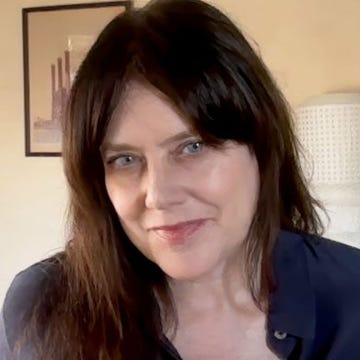
Next to the White Sands Ranch, near Alamogordo in southern New Mexico, was a monkey farm whose rhesus macaques Albert 1, Albert 2, and Albert 3 were sent up in V-2 rockets. One crashed near the ranch. The image of these monkeys, along with a family story of a man in a space suit who floated down into a corral in a military balloon in the 1960s, informs the striking opening of Joshua Wheeler’s first novel, The High Heaven (2025), in which a rancher and his son, Oliver Gently, find a live monkey inside a missile. Wheeler, who grew up in a storytelling family that owned the ranch, hearing their lore at the Church of Christ services they held, thought, “What if a monkey was the first Earthling ever to be in space, and these ranchers ended up with it?”
Over Zoom from an empty classroom where he’s just finished teaching, Wheeler also speaks to me about being a teenager and going to the grave of Ham the Astrochimp, the first primate in outer space, to get high. It’s one of a host of true vignettes he shares, some of which, imaginatively transformed, grace The High Heaven. The novel, rich in symbolism, is organized as a triptych around the Metonic cycle, a period of 235 lunar months, or roughly 19 years. The history of Alamogordo has provided ample fodder for his work. Both The High Heaven and his 2018 essay collection, Acid West, are well researched and fascinating.
The novel relates the life story of Izzy Wheeler, who as a child escapes a cult after a skirmish and is taken in by Oliver and his wife, Maude, in 1967. Izzy grew out of another story that Wheeler had heard from his family: In the ’60s, a young woman who’d been raised in a cult and ate dandelions came to live at the ranch. For the novel’s first section, Wheeler made her younger in the character of Izzy, a girl with eyes like “trinitite,” so that he could explore the whole arc of her life.
This article appears in Issue 35 of Alta Journal.
SUBSCRIBE
It’s a trope of the Western, Wheeler muses, that “a crotchety-old-cowboy type” ends up with a child who “changes his outlook.” In many such stories, a young girl or boy is a “special child,” and “the fate of the world is in their hands,” as Wheeler puts it, and the story’s emphasis is on the older person’s change. Wheeler evokes the trope but also interrogates it. “We’re going to move beyond the end of True Grit, or beyond News of the World, and follow that girl for the rest of her life,” says Wheeler. “Because being a special child is its own kind of burden that a lot of those sorts of stories have no interest in pursuing or portraying.”
The three sections of The High Heaven play with different genres. The first section, which ends in a tragedy that shapes the book, is called “A Tale of the Acid West.” The second section, a picaresque, describes Izzy’s life meeting eccentric people on the road in Texas. To research this middle section, Wheeler rode his bike through towns along the 2024 solar eclipse’s path of totality. The third section, set in New Orleans and styled as a speculative Southern gothic, sees Izzy become a therapist for those who are moonless—they can’t see the moon—though she remains haunted by what happened in southern New Mexico. Embedded in the story are cosmic cycles—like the Metonic—that Wheeler found challenging to keep track of.
Another of Wheeler’s challenges was crafting Izzy’s interiority. To get in the mood, he wrote much of the book wearing a pair of coveralls. “I sort of cosplay,” he tells me. “When Izzy started to materialize, and she was wearing these as part of the cult, and it started to become a motif throughout her life, when I would sit down to write, I would put on the coveralls, and it was like, OK, now I’m working on this thing… I don’t know, it’s Pavlovian or something.” He also gathered as talismans things that Izzy collects, such as a Galaxy radio and old TVs, and tinkered with them. The phone Izzy has in the third section, a Samsung Galaxy that she streams from, keeps overheating as it scans her irises; it was the phone he owned for a long time.
Wheeler mentions that he had no idea how others might see his home until he left New Mexico to attend the University of Southern California. It was in California that he first thought, “I’m from an interesting place that people want to know more about.” But it was going home to attend an MFA program in poetry that made him realize, “Oh, I could spend most if not all of my life trying to tell the stories about this place. There would still be an infinite amount of stories to tell.”•

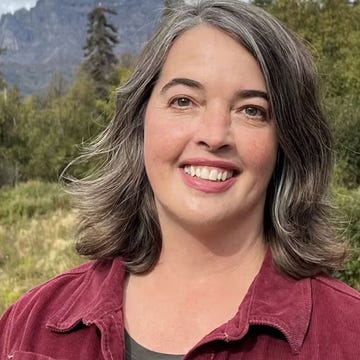
Anita Felicelli is Alta Journal ’s books editor and the author of How We Know Our Time Travelers, Chimerica, and Love Songs for a Lost Continent.