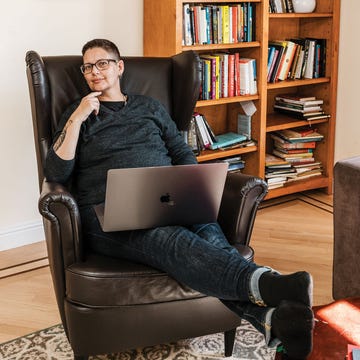
San Francisco–based Annalee Newitz is the nonbinary author of nine fiction and nonfiction books characterized by an expansive sense of possibility around science and culture. Two of their science fiction novels, Autonomous (2017) and The Terraformers (2023), and a couple of stories are set in a timeline in which robots with what Newitz calls “human-equivalent intelligence” have, to varying degrees, received civil rights.
Newitz’s most recent work, the cozy near-future science fiction novella Automatic Noodle (2025), set in 2064 San Francisco after a war involving the secession of California from the rest of the United States, fits into that broad fictional timeline of sentient robots with rights.
In the book, a quartet of these robots, militarily trained, decide to make and sell biang biang noodles under the moniker Authentic Noodle. But as a result of a robophobic review-bombing campaign that seeks to damage the restaurant’s reputation by calling it “Automatic Noodle,” the robots find themselves unable to gain new customers. The word “authentic” is favored by the algorithm powering the reviews app. HEEI—or “human equivalent embodied intelligence”—laws add complications to the ownership and public image of the restaurant, echoing Autonomous’s provocative exploration of ownership and rights, but posing more contained questions.
This article appears in Issue 34 of Alta Journal.
SUBSCRIBE
Automatic Noodle can be read as an allegory about society and power, about the resilience of any marginalized community in the face of oppressive tactics used by those within the dominant culture. Despite the dystopic conditions of the war that these characters have emerged from, the novella is heartwarming. When I speak to Newitz over Zoom, they note that what we’re living in now is the beginning of a culture war that feels like the start of a real war; the book was partly fueled by Newitz’s desire to be living in the time after the war is over, when we are experiencing “renewal and rebuilding and reconstruction.”
Newitz talks about a friend, Michi Trota, a Filipina food writer and chef, who hates the word “authentic” when it comes to food because it’s so often used as a “cudgel by the dominant culture to police what food and culture a group is allowed to express in the public sphere.” Newitz explains that the algorithm in Automatic Noodle is written by people from the dominant culture who use “authentic” this way.
Newitz grew up in Orange County, surrounded by diaspora cultures, and many of their friends also struggled with questions of authenticity. In Automatic Noodle, Newitz explains, they wanted to capture the feeling that identity is fluid and “that trying to pin people down to being authentic is actually a way of flattening them out and caging them and culturally keeping them out of time, in a way, because authenticity is often associated with a past identity.”
Newitz reflects, “How weird it would be to be even one step more removed from all of these diaspora cultures and be like, Wow, not only am I not part of any of these cultures that I think of as my culture, but also I’m not even human, so I don’t even know what it means to be authentically contributing to human culture, because there’s never been robot culture before.” They liken this to queer culture, which must grapple with the suppression (or possible nonexistence) of community histories.
The robots of Automatic Noodle—Staybehind, Cayenne, Sweetie, Hands—are well differentiated as characters, in part because of careful attention to their physical attributes. But making the robots three-dimensional also involved making their dialogue distinct—thinking about what kinds of verbal ticks would suit who each robot was inside.
Research pulls Newitz into the world-building headspace for fiction writing. Among the calming rituals they use to write, however, is listening to certain soundtracks while writing particular books. For Automatic Noodle, Newitz listened to midcentury jazz, particularly Art Blakey and Grant Green. Newitz says, “These are people who were themselves composing in the 1950s, so it was right after a horrible war and also during the beginning or during the civil rights movement.”•

Anita Felicelli is Alta Journal ’s books editor and the author of How We Know Our Time Travelers, Chimerica, and Love Songs for a Lost Continent.