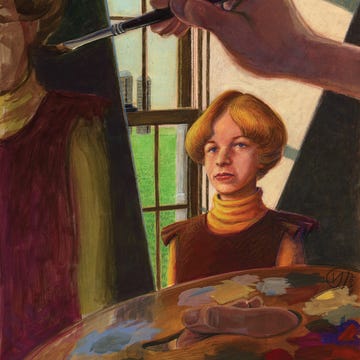
Doodles on every page in his notebook. Intricate, elaborate studies. Quick, pocked sketches. All of pirates. Their stances are wide, chests flung out and swathed in ruffles. Their sharp eyes glitter, darker than their long ringlets. The way he draws them, they look like 19th-century engravings. They ride egg-white waves rimmed with grape ink, and the waves seem so substantial, so real, the fact that they are made of ink seems incidental. Small somber ships sail here and there in the background, but mostly the pirates wade in ocean water, arrogant and frilly. They are enthralling, but of course, I don’t admit that to Brian.
Instead, I stare down at my biotechnology textbook and solve the problems in the back of the section. The problems are clean, too easy. I finish before everyone else and look around at the sea of heads. Everyone else is still hard at work, hunched over the long tables. All young men. I don’t know why Brian is here. He’s not interested in biotechnology at all, but he probably thinks he’s better than everyone else, too much of a genius not to take the most advanced classes our community college offers.
This story appears in Issue 34 of Alta Journal.
SUBSCRIBE
All the students treat me as if I’m a man, too, and my dark brown bob doesn’t ruin that impression. Half the class has shoulder-length hair. Divisions based on ability have been made, and political alliances have formed, but nobody has befriended me. I’m stuck in a dark corner with petri dishes, micropipettes, an old computer, and Brian, who ignores me with a kind of vengeance, except when we have to do labs. It doesn’t matter, I guess—the friendships or the lack of them. Not even my best friend since middle school turning into an asshole matters, really. It’s the precision of the answers, the systems that need cracking, the game that waits to be won, which interest me. If I can crush the science, none of the rest of it can touch me.
”Hurry up,” Brian says brusquely after the bell rings. He stands, looking at some point above my head and twirling a strand of his long, dark hair. He started growing it a couple years ago around the same time he started lifting weights, and he considers himself a modern-day Samson.
“Just a sec.” I shove everything into my backpack.
The science buildings run along the west side of campus, abutting the suburb where I live. We walk down the street several feet apart, although we are traveling to the same destination—my house. Brian visits my grandfather, Dane, after school every other weekday, helping him write his book and organize his coin collection. Dane is a retired Stanford historian who is working on a book about currency and power. “That kid,” he says about Brian, “is so sharp and motivated. He’s going places.” They lock the door to Dane’s study and don’t come out for hours, but I haven’t seen anything tangible come out of all those hours they spend together.
“How was your day?” I ask politely as we walk up the path to my house. He glances at me briefly through his curtain of glossy, curly hair.
“All right.” On the porch, he pulls it back with a rubber band.
“Those are bad for your hair. They’re too tight and pull at your roots.” I fumble in my pocket for the house key. He stands there, silent. I want to rail at him, but I don’t know what I’d say, what viciousness might come out of my mouth. Before Dane moved in with Mom last year, back when Appa, my father, threw up his hands at Mom’s wild mood swings and left us to go back to India, I’d assumed those perfectly arranged coins in their plastic pockets were a bond between Dane and me. Dane had stories for all of them, and the way he told them, he made it seem like the stories were mine, not random dusty tales from his years teaching history at Stanford but stories he’d invented especially for me. The house was empty and lonely without Appa there, but it was also much quieter, and that was, maybe, a good thing, because my father’s temper had been a noisy conflagration, the sweetness of apology, and then another rage, triggered unexpectedly, arbitrarily. Every time he was set off, or set himself off, Mom was reduced to weeping. There had been something so reassuring about escaping to my grandfather’s house on the weekends, walking in the park with him, getting coconut sundaes with him—listening to someone who liked to talk at me, not yell at me. Appa and Dane didn’t get along, but eventually I realized that it was partly because they thought the same way. Both of them wanted to be alpha. Dane saw me as similar to my mom and her mom: just someone who would give up any spark of ambition in order to bear children. He never asked about my life or about what I was learning about science or about my internship at a bioengineering company. But the truth was, so long as his condescension led to me knowing more than everyone else, I didn’t care. Not much, anyway.

Everything shifted the spring before last, when Dane moved in, just before my high school graduation. Brian and I were sitting at my kitchen table talking about 7th Sea, a role-playing game we were playing with our friends later that night. We were hanging out back then, and every once in a while it seemed like something would happen between us, but it was all pretty ambiguous because we’d been best friends before that for such a long time. Brian had on leather pants he’d shoplifted to wear to the game. From outside the sliding glass door beside us, the oak trees cast shadows on his face. He leaned forward to hold my hand. Then we heard a crackling noise and jerked away from each other. It was the creaky sound of Dane as he came down the hall, wearing a smoking jacket pulled over his long johns and carrying a book.
I introduced my friend as Brian James.
“A boy with two first names, eh?” said Dane, his furry eyebrows raised.
“Eh,” Brian replied. My grandfather chuckled and put down his book. Fifteenth-century coining. Snore.
Brian interrogated him about the book for so long, my grandfather lent it to him. Brian and I stopped talking as much soon after. It turned out what Brian wanted was someone knowledgeable. I may have known a lot about kings and wars and highwaymen and pirates compared with the other kids he knew, but I was nothing next to Dane. So much of what I knew came from Dane’s stories.
Now I unlock the house door and notice a note on the footstool in the foyer.
“Ruchi, I’ve gone to the store. Tell Brian I’ll be back in an hour—Dane,” I read aloud. It’s the first time my grandfather has been late to meet Brian. I hand him the note, drop my backpack next to the door, and walk into the kitchen.
Brian follows me.
“What do you want?” I ask. I’m exasperated at his silence.
“A chair. A place at which to seat myself.” He enunciates as if I am stupid.
I point him toward the oval kitchen table. Brian has visited regularly
for the past six years and more often since Dane moved in. I think he should know not to sit in my chair, but he does, displacing the baked-bread scent of our kitchen with his own musky smell. He plucks a notebook from his backpack as I approach the table with two cups of Darjeeling tea and a plate of the cheedai that I bought at the Indian market last week. Whenever I visit the market, I revel in the sandalwood incense the clerks burn and remember what it was like to go there with my father on a good day, on one of the days when there was no rage. Appa would identify the snacks he’d eaten in his childhood. I’d choose one to try. We’d laugh at the expressions of consternation on Mom’s face as she valiantly tried them. By the time he left us, I’d tried everything in the store.
I look out the window as Brian draws. I sip my Darjeeling. He’s drawn me as a pirate, my short fluff of hair covered with a scarf and the pointed toes of my boots jutting out from a shallow pool.
“Now I own you.” Brian’s dark gray eyes gleam. He grabs his cup of tea and slurps it up noisily. The carelessness of his drinking makes it seem like what he’s said with such certainty is beyond contestation.
“Fuck off.” My words sound crippled. And why do I look ugly in this picture, while all the other pirates he draws are beautiful? I pretend to drink, hiding my eyes in the cup.
“Lighten up, Ruchi. It’s just a joke.” He sounds almost friendly again. “You used to love pirates.”
“I still do. They’re free.”
“You like them because you imagine they’re romantic,” he says matter-
of-factly.
“And you don’t?”
He sketches himself higher than me on the page with a rapier’s tip caught in the lace fichu concealing my collarbone. At least he didn’t slit my throat. “They weren’t really romantic. They were mean, bloodthirsty, braggarty guys that were full of syphilis and scurvy,” he says.
I know this is true, but I don’t have a reply. Why ruin a perfectly good fantasy with the gritty, ugly parts? What I’ve learned is that there are always ugly parts.
“Truth is, you wouldn’t have been tough enough to be a pirate,” he informs me.
“I never said I wanted to be a pirate.”
He rolls his eyes. “Well, good.” He munches the cheedai.
I change the subject to something my grandfather probably knows nothing about. “You still shoplifting?”
“I stopped for economic reasons.” He launches into a lecture about how shoplifting isn’t intrinsically morally wrong, but can eventually lead to food deserts. Long, winding sentences like my grandfather uses, multi-syllabic words that require so much attention to decode, you can’t quite argue against them. I rest my chin on my folded arms, burying my nose in fuzzy cotton sleeves that smell like baby powder, watching Brian as he continues to talk. I pretend to pay attention, nodding at the right moments.
My eyes close in the course of him bemoaning the closure of Target. In my dream, Brian is the pirate king who has taken all of the loot. It bulges in his sack. “It’s nothing but Darjeeling,” he explains. And then he is kissing my mother like in the final scene in an old romance movie, which clues me in that this is a dream; in real life, my mother ignores him. She ignores all of us, claiming she has a headache most nights.
I wake up to Brian running something cold and sharp down my spine, lightly, as if he’s finding the perfect spot to cut. He notices I’m awake, hunched over the table in shock. I realize it’s a knife. Anger washes over me, paralyzing me, and the moment it lifts away, I swing my fist at his jaw, but I have never hit anyone before and he starts to duck, so I barely graze his forehead.
I’d try again, but he grabs my hands together with one of his and pretends to laugh. He’s furious I dared to fight back. Then he puts the knife up against my breast, circling it deliberately and slowly with the blade. His pants are coming off in a kind of herky-jerky motion, as if he’d unbuttoned them while I was napping, and he wiggles his hips to get them down around his ankles. For a second, I wonder if my heart is beating. I keep trying to get my wrists free, but he’s got the flat side of the knife pressed to my breast. He lets go of my hands to pull his pants all the way down. When I see the bulge in his crotch area straining against the dull white cotton, I bring my knee up with a quickness.
The knife drops, and he’s huddled on the floor holding his crotch for a minute, shouting, “Bitch. What the fuck?” He keeps swearing.
I grab my keys and run out the front door.

When I return after dark, having taken refuge at the library, my mother and grandfather have parked in the driveway. I come inside cautiously, but Brian is already gone. He’s left the picture of him holding a rapier against my chest on the desk in my room, like it wasn’t enough that he nearly raped me. He also needed to leave a memento of what happened. He probably thinks Dane wouldn’t believe me—the picture is scabrous, so cartoonish it could only be meant in fun, rather than as verification of his ill intent. Bitch. What the fuck? Any pretense of sophistication dropped. When pushed, he cussed like the creeps on internet forums when talking about some random woman.
I should’ve done something more, called the police or kicked him in the ribs while he was lying on the floor. I pick up the paper and study his version of me. I can’t bring myself to throw out the picture even if it is a souvenir of an attempted rape; I’m so repulsively drawn, the image fascinates me, all the angular planes of my face in purple shadow. His style has evolved. I still have all of the ink vampire drawings he gave me for my 14th birthday. He had come to my birthday party and handed me a sheaf of paper, tied with a green-and-gilt silk ribbon. I put the present by the fireplace. We played Risk until other kids arrived. The other kids wanted to play spin the bottle, and so I wound up kissing someone, not Brian. We opened presents, and everyone oohed and aahed over Brian’s present. Even then, he could draw with confident, feathery strokes and a startling verisimilitude.
I walk out to the kitchen, where Dane is sitting, playing solitaire. I sit down and convince him to switch to blackjack. I think about how to tell him about Brian, whether it would be worthwhile to disillusion him. But maybe it wouldn’t really be a disillusionment—I feel like he sees the real Brian and I’m the one who was always suffering under some kind of delusion about who Brian was. When he would shoplift, he had me convinced he was motivated by some kind of “rob the rich to feed the poor” idea. After all, he lifted from Target and Walmart, not mom-and-pop shops. I even romanticized it a little, shoplifting as a form of dissent against capitalism. But after what happened with the knife, I realize he just doesn’t give a shit about boundaries. There are no hard-and-fast lines for him, nobody and nothing he wouldn’t violate if given the opportunity.
“Why didn’t Brian stay?” my grandfather asks.
I explain that he had stuff to do.
Dane says, “I wish you’d realize you and Brian are incompatible, Ruchi. You’ve got to get over this.”
“What are you talking about?”
“You have a crush on him, right? He told me that you’ve been pining after him a long time.” My grandfather leans forward over the table, his round chin looming like a large pat of dough. “Eventually you’re going to get married, have a kid or two. Brian’s brilliant, has a bright future. I’ve no doubt he’ll be a star in academia. I’ve been writing him a recommendation to transfer to Stanford.”
“You what?”
“He asked me to help him get into some of the better universities to get his bachelor’s.”
“And you agreed?”
“Mm-hmm.” He lays out two face cards, a king and a jack, to win the hand. I think of what it must have been like to be my mom growing up with him, how difficult it must have been to ask him to move in with us after Appa left. I don’t know if she’ll ever get over my father abandoning us. I see how the melancholy—always there in streaks when Appa was here but broken up by excitement, mirth about nothing—has invaded her all the way to her bones, and I don’t think she’ll get over it. I hope I don’t end up like her, passive, ruined.
“He tried to rape me,” I say, trying to look into his mist-blue eyes. I don’t see any shift in his face, any recognition or worry. He doesn’t even look at me.
“Come now. Brian?”
“Yes.”
“Boy’s got a bright future ahead. I’m sure you misunderstood.”
“I know what happened,” I say. “Attempted rape.”
“Don’t go messing up a boy’s future with these kinds of claims, Ruchi.”
“I can’t believe you. Are you being serious right now? Really?”
“Don’t be dramatic. He’s been a great help to me this past year, and I’d like to think I know him a little bit better than you do.”
Mom comes in. We stop talking and look at her. “What?” she asks. Neither of us says anything. When she comes home from her shift, there’s no talking to her, not about anything important. She met Appa waitressing at Olive Garden, back when he was working at a startup. He thought the restaurant was exotic, and certainly he thought my mom was, with her platinum hair and turquoise eyes. She quit for a little while, but now he’s gone, and she’s back there waiting tables, eating salads with extra peperoncini and breadsticks for her shift meal, dealing with the lowlifes drunk on cheap wine who try to pick her up in front of their dates. She disappears up the stairs. The gurgling rush of water running into the tub. She’s drawing her nightly bath.
That night, we eat warm pads of meat and buttery-slick corn. My mom and I listen to Dane speak about some history conference to which he’s been invited to give a keynote address. Mom’s thrown together trifle for dessert. I stir the trifle, mixing whipped cream through the cold strawberries, the orange slices and grapes, their juice staining the white peaks. I go upstairs to do a problem set, but I can’t solve the problems. Black numbers hover above the white page like skinny, contorted animals. I play chess instead. First, I play a real game with myself, trying to make it last as long as possible for maximum suspense, the way Appa taught me. But before long, the chess pieces run riot. The white king rapes his rook. The black queen seduces a white pawn. I’ve never seduced anyone, just barely gone beyond a hand on the knee at a Scorsese film, and yet there is something in this boldness that appeals to me. A black and a white knight team up and betray both of the kingdoms. They shinny up a green shoestring hooked over the castle walls, swim the perilous moat, and dash across the borders of the game to freedom. Sometimes crossing boundaries produces fireworks, and sometimes it means a beheading—it’s a gamble every time. The phone rings for me, but I tell my mom to say I’m not home.
The next morning, I feel dirty. I smell of sour sweat, and my usual hot shower makes it worse. I load my backpack with lunch, books, a pair of utility scissors to cut tubing in lab.
During microbiology class, the instructor is up at the blackboard all hour, waving his spidery arms around and drawing huge diagrams with red and white chalk. Brian and I don’t speak. I look at him once and he glances back, his gray eyes like narrow greedy slots on the tops of piggy banks. From my desk, I see that the pirates he’s drawing are dying on the beach and kissing languid women. I do not know what happened to him, how he changed from somebody I knew and trusted to this other person, who must have been underneath the trappings all along. I think about his trying to rape me, running that knife up and down my spine so casually, as if even my skin were not a sufficient barrier to protect me from him. I remember him and my grandfather bending over a shimmery pile of coins in a cloud of dust, sliding each coin into plastic, choking each glow, and recording each dry fact. I think of him talking about syphilis and scurvy.
I look inside my backpack for an eraser, and from its dark recess, my weapon glints. Cold, polished, modern. Yet, to me it is a pair of blades not unlike the rapier in Brian’s picture. He’s stuffing his notebook into his man purse, and just that gesture fills me with a hot, blinding anger. What would level the field? Through what act can I volley my rage where it won’t just ricochet, impotent, through a sturdy, impenetrable universe? Perhaps nothing will be enough, but I think I know how this game should be played. When you’re with someone whose strategy is brute force, who never honors rules and boundaries, you can’t honor them either. You go for broke. A pirate does nothing less.
I move behind him. With a satisfying pinching of my thumb and forefinger, his long, glossy curls, in one ponytail, are cool and inert in my hand. Brian looks up with a cry, but I am out the door and off campus, half skipping down the street with my loot glittering in the afternoon light. It is my pound of flesh, like the taking of a maidenhead, like a mass of old coins brought to the surface of the sea.•
Anita Felicelli is Alta Journal ’s books editor and the author of How We Know Our Time Travelers, Chimerica, and Love Songs for a Lost Continent.